THOUSANDS OF FREE BLOGGER TEMPLATES
Showing posts with label Strange. Show all posts

Saturday, October 13, 2012

Dragon tent

The Chinese city of Qingdao set a Guinness World record today on 13 October 2012. During the annual Beach Camping Festival a set of 900 tents was set up to represent a Chinese dragon. So the largest tent mosaic ever was created!


Friday, August 3, 2012

Tibetan train and antelope photoshop


Above posted picture used to be an Chinese award-winning photograph in 2006, celebrating the symbiosis between the modernization of China and its focus on environmental protection. The setting is the vast Tibetan landscape where the Qinghai-Tibet train is cruising through the picture. In the front of the picture a herd of Tibetan chiru deer are seemingly captured by camera.
 
Of course this is old news, but I stumbled on this extraordinary news by doing some research on preservation and environmental protection in China. I thought it was such a bold and typical Chinese way of making the Chinese population proud of the enormous economical advances while keeping a tight grip of troublesome areas like Tibet.

The chiru deer is an endangered species because it is and was hunted for its wool. In recent years the population has grown and China loves to use the chiru, which is actually a kind of antelope, for promoting the nation's preservation efforts. The Tibetan antelope was also used as a mascot, called Yingying during the Olympic Games of Beijing.

While the Qinghai-Tibet railway is a one of the many super works the Chinese government realized in recent years. The whole project measures 1956 kilometers of railway tracks, from which 550 km over permafrost. With an elevation of 5072 above sea level it is the highest train in the world. It was long considered an impossible mission, especially constructing a track though the Himalayan mountains. But the Chinese engineers persisted and needed 675 tunnels to conquer this problem. Probably one of the most daring engineering feats of human history.

But it was also a very controversial project for two reasons. Firstly because it tightened China's grip over Tibet. Starting from 2006 an influx of Chinese invaded Tibet and the Han Chinese population is nowadays greater than the Tibetan one. Hence the yearly problems of Tibetans burning themselves in protests, as everything is controlled by Chinese and all the jobs are give to Chinese instead of Tibetans.

Secondly there were many points of criticism advocating the destruction of nature and habitat for several species. One of those species was of course the Tibetan chiru.

The railway was specially designed with "corridors" to let the wildlife untouched by the railway. These corridors are the spaces between the pylons supporting the railway. Environmentalists claim the Tibetan chiru is too shy and would never come near the man-made railway, especially not when trains would be cruising through.

And this is why photographer Liu Weiqing came to Tibet to prove that there can be perfect harmony between the mega project and the nature surrounding it. Mr Liu is working for Xinhua, the biggest state-owned news agency and he tells a story of waiting for 8 days in a pit near the railway to take this perfect shot. The picture was acclaimed by CCTV, the Chinese state media and was elected to one of the "10 pictures of the year". The picture was used as perfect propaganda and was even used to plaster the walls of the Beijing subway.

Unbelievers opened up internet micro-blogs to contest the incredibility oh this picture. Biologist commented that it was strange that in the picture pregnant antelope were accompanying the herd, while there were no youngsters. The first train departed in July, just after the antelopes would have been given birth, so youngsters should be seen and pregnant antelopes would only be expected one year later.

Photograph experts questioned the possibility to capture a fast moving train in the background with a slower galloping herd in the front.

So finally it was detected that the picture was a fraud. Two pictures photoshopped together. Mr Liu had to publicly apologize and some media published an apology for circulating the photo.

A piece of perfect propaganda was blown to smithers!


Friday, April 13, 2012

THAI airways makes a joke

Is this only possible in Thailand?

I was complete stunned today when I took my afternoon flight from Chiang Mai to Bangkok. The airplane was brand new with good seats, personal screens, even an USB port. As I was enjoying my luxurious new seat I was studying the Thai Airways magazine and the inflight entertainment magazine. Next I examined the safety pamphlet in the seat in front of me. As usual it states that phones and electronic devices have to be turned off. On the pamphlet 3 phones are shown: a Iphone, a Blackberry and a Motorola.
As many of my friends have these phones I looked at them a bit closer. I could see that the brand name has been changed, which is quite normal, but the names given are very unusual.

The Iphone doesn't have a clearly definable name.
But the Motorola is called Wienorola and the Blackberry is called Crackberry.

Now maybe this is my Freud mind playing tricks on me but "wiener" and "crack" would be informal names given to respectively the male and female intimate parts.

I am sure the designer had a lot of fun, but I can not understand nobody noticed this before printing these pamphlets for the new THAI airways aircrafts. But once again maybe I am just seeing this that are not there ...

Anyway I had a good chuckle in the plane seeing this. Did anybody else noticed this sign before?

Sunday, April 1, 2012

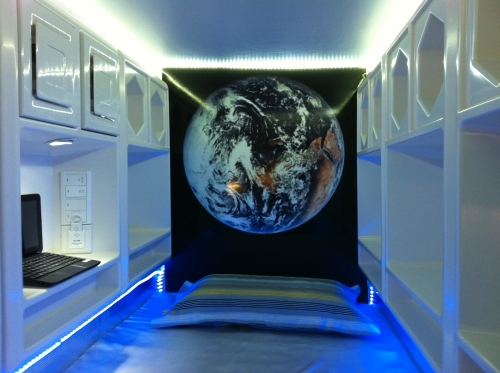
Galaxy Capsule in Hong Kong

In an earlier post I described my experience sleeping in a capsule hotel in Tokyo. Those tiny coffin-like rooms were very typical for Japanese big cities, but since last month the capsule hotels have made their way to Hong Kong!

Galaxy Stars Limited, a Hong Kong company, want to open several capsule hotels.
It would mainly target budget travellers as a basic hotel room in Hong Kong would cost you about 150 $/night. A night in a capsule would cost around 30 $/night. The pods or capsules would measures about 90 by 180 centimeters and will be equipped with all the necessities a modern traveller needs, like a flat-screen TV, a power socket, an air conditioner and even a small ledge for a laptop.
It is expected that especially mainland Chinese would go for this cheap option. Last year many tour groups from mainland China stayed at love hotels to cut down the heavy costs. Maybe the capsule hotels might offer a more elegant solution.

These capsules are also seen as a perfect way to build student dorms and student would be able to rent a pod, with communal bathroom, for about 400 $/month.

Galaxy Stars Limited hopes to open its first capsule hotels in the tourists areas of Tsim Sha Tsui, Mong Kok and Yau Ma Tei. One problem however might be to get approval from the fire department.

Thursday, March 22, 2012

Hidden Messages in Water?


Japanese author Masaru Emoto started his research about water crystals by freezing water to see if it would form crystals like snowflakes do. He froze water for 3 hours and photographed the results with his microscope. He also discovered that different sources of water gave different water crystals.

The amazing thing, according to his research, is that the water crystals changed into even more beautiful water crystals if music was played to the water before freezing it.
As water is a living thing it can store information and this encoded information transforms the structure of the crystals.

Mr Masaru takes it even further and has different experiments where water transforms into beautiful crystals when nice words, chanting or smooth music is played in front of it and transforms into ugly deformed crystals if negative words or music is recited to it.

Further developing his theory he also suggest that water, which is imprinted with positive energy, can be used as an effective medicine. He uses  "Hado" water, hado is a Japanese word meaning very subtle vibration that can not be perceived, in alternative medicine and would have cured already some 10.000 patients with his innovative method.

As much as Mr Masaru has been praised by common people for his research on water crystals, as much has he been criticised for insufficient scientific proof. He is depicted as pseudo-scientific by many professors.

Several of his "Messages from water" books have turned into bestsellers and about 2 million copies of his books have been sold worldwide.


There are many interesting video's on the web about those water crystals and Mr Masaru, just check it out. I was very surprised by one video showing the effect water has on the growing process of rice, seen in the video down here.


Sunday, March 18, 2012

Does Superman come from Korea?


We all have been indoctrinated that Superman is a comic hero developed by American writer Jerry Siegel. And it is also clear that superman is coming from the planet Krypton. His parents send him as an infant to earth, just before the destruction of his home planet. And on earth he grew up, got himself the nickname Clark Kent en saved the planet from several catastrophes and malicious evil plans.


But what if the creation of superman was based on an old Korean sign?


We all know the South-Korean flag, called Taegeukgi. In the flag we find in the middle, the ancient Yin-Yang sign. Not as we usually know it in black and white, but in red and blue.
Yin and Yang symbolise in the old Chinese philosophy all the opposites in the world like: negative and positive, woman and man, moon and sun, ...
And so in the Korean flag blue is Yin and red is Yang.


Next to the Yin Yang sign you will find 4 trigrams taken from the Yi Ching, which is the very old Chinese Book of Changes. This book was and still is used for divination practises.
Upper row from left to right are the trigrams for heaven and moon. While the two lower ones from left to right are sun and earth.
Interesting flag isn't it!


Another sign seen very often in Korea, especially on historical buildings is the Sam-Taegeukgi.
So we still find the round Yin Yang shape but no duality between 2 colours, here a third colour is present. As seen above, here blue represent Yin and so represents Heaven. Red was seen for Yang en represent Earth.

The new colour is yellow, which stands for the middle and Humanity. Even in ancient China the Yellow emperor was the only one allowed to wear yellow as he was the connection between heaven and earth. 


So in this Korean sign it is clear that the duality between Heaven and Earth, Negative and Positive, and all other dualities in the world effects humans. But as the yellow colour also spins around equaly as red and blue it can influence Heaven and Earth as well. All three are connected and influence each other.


So going back to superman. When we inspect his attire these three colours are coming back. His cape and boots are red, his suit is mostly blue and his belt is yellow. The Superman logo is a yellow and red sign on a blue background, normally visible on our hero's chest.  Superman forms the human connection (yellow) between heaven (blue), his former planet Krypton, and earth (red), where he is Clark Kent and changes in Superman to kick some serious butt in name of goodness. Would it be pure coincidence that blue, red and yellow were used to depict superman?


Wednesday, December 28, 2011

Thai pickpocket

Sunday, December 18, 2011

Foxface - Curious Japanese fruit

This fall I noticed different Ikebana pieces in Japanese hotels which were included a strange yellowish kind of fruit. Japanese people told me it was called "Kitsune gao", meaning Foxface.
Searching a bit further on the net it was revealed that "Foxface" was also commonly used in English. Other names for this strange fruit are: Nipplefruit, Titty fruit, Cow's Udder, Five fingered eggplant or 'Apple of Sodom".
Foxface would be family of eggplants and tomatoes, and bears fruit in fall.
The fruit is not edible and even poisonous, but it is used for decoration. And it is perfect to fit in ikebana pieces as it doesn't require water and will last for two months.

By the way a person called "Kitsune gao", fox face person in Japan, would be considered a person with feigned ignorance.


Sunday, December 4, 2011

Most expensive crash ever

This weekend an extraordinary accident happened on the Chugoku expressway in Japan.
The crash included 8 Ferraris, 3 Mercedes. a Lamborghini. a Skyline and a Prius.
This would be the most expensive crash ever.

Thursday, October 20, 2011

The Porsche street vendor

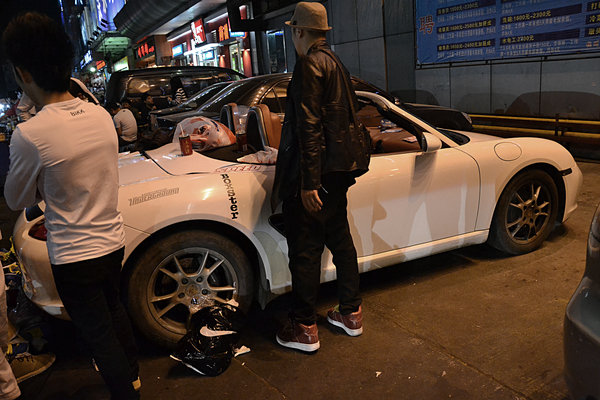
In Hangzhou, Zhejiang province, China, a street vendor selling fashionable sneakers arrived in his white Porsche and started to unload his wares from his car's trunk. China is doing economically well and it shows!


Wednesday, August 24, 2011

Female businesscards

Chinese hotels are always a big adventure. Is my booking made?, Will I get the room I booked?, Will there be a person speaking some English?, ...

Upper-class hotels (4 or 5 stars) will not have a lot of problems as the management is competent and the staff is well-trained. But staying in a 3-star Chinese hotel might give you some surprises. For example you are woken at night by the telephone and when you pick up some sweet voice asks you if you would like a massage. This is common procedure in those hotels as the staff tries to make some extra money and sells the information to which rooms single man are spending the night. Quite annoying if you came to a hotel to actually get some sleep.
In those hotels you will also find a lot of female business cards shoved under your door, for the same purpose as well. I took some pictures of them and I really wonder what does "Massge temnder care lighting your booy"?


Tuesday, March 29, 2011

Kopi Luwak - expensive coffee


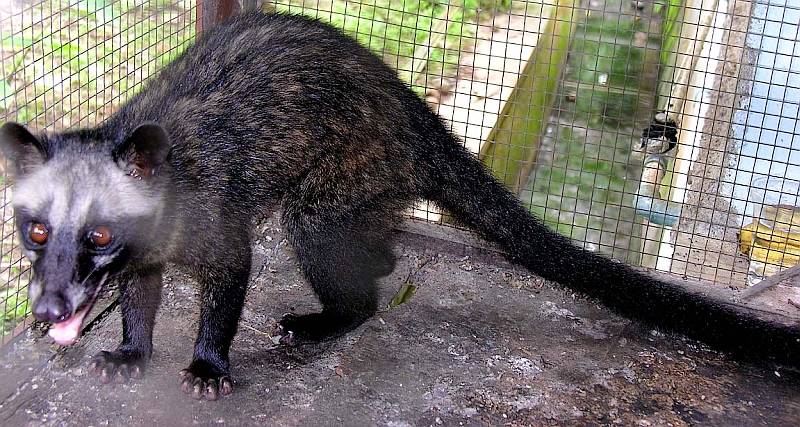
Kopi Luwak is the most expensive coffee in the world. The Kopi Luwak is mainly produced in the Indonesian archipelago. A cup of Kopi Luwak can be sold for around $50 around the world.
A special animal called the Asian Palm Civet is needed to obtain this pricey coffee. This is animal gives the strange name to this coffee. Kopi is the Indonesia name for coffee and Luwak is the local name of the Asian Palm Civet.


So what is so special about this coffee? First of all the process to collect the beans is quite extraordinary.
The coffee beans, which are cultivated on fields, get eaten by the Luwak. The fruit pulp gets digested by the Luwak, but the seeds pass by the stomach and are defecated. Inside the Luwak's stomach and intestine the seeds get some time to ferment and give the special taste to the coffee. The dung of this animal is collected. The seeds are washed and sun dried. After this process the seeds are slightly roasted as to keep their special taste.


So how does it taste? A bit difficult to describe. As i tried this coffee, I felt it didn't taste bitter as most coffees do. It had a mild and even fruity taste.
But damn it's expensive for a cup!

Wednesday, March 2, 2011

Invisible man from China

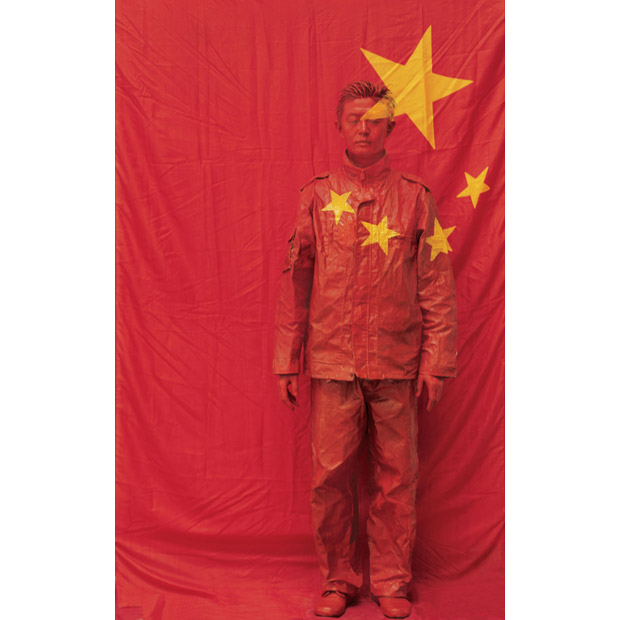
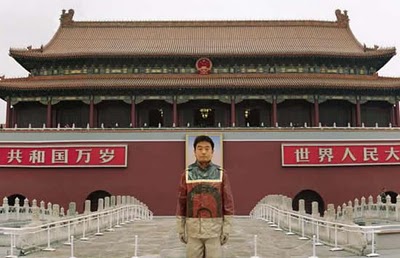
Liu Bolin is a Chinese Photographer-artist. He specialised himself in the art of invisibility and is now famous for his special art form. He will study a place and then paint himself so as to melt away in the picture. Every pictures takes him more than 10 hours of work.
Some of his works have a political undertone and in 2005 the Chinese government closed down his art studio. This didn't stop him and he now has a International reputation.

He work is sometimes compared to the children books "Where's Waldo?"


Wednesday, November 17, 2010

Funeral in style

In Sout-East Asia Buddhism and Chinese beliefs dominate the religious thinking. So when "Nirvana Memorial" planned to build a luxury columbarium in Singapore, they did it in style.
According to Chinese traditions a deceased should be buried in one piece and commemorating ceremonies should be held at least twice a year. Singapore has a limited land space so cremations are generally performed.
In the brand new Nirvana Memorial Garden columbarium, called a "6 star" columbarium, everything is possible.
The urn of the deceased are placed in golden platted walls. Ceremonies are held without the presence of monks but with light- and sound shows and speaking Buddha statues.
Gloomy, dark and depressing funeral places for your beloved ones are the past, this is the future.

But it comes with a price tag;
A Royal double niche would be price around 22.000 $ and Family suite (32 urns) comes for 93.000 $. The "economy" class niche starts at 2.200$.


Friday, September 10, 2010

Green hat


Chinese is a difficult language to master. It has it's own writing in characters, almost no grammar and short pronunciations according to tones. These tones are for foreigners probably the most difficult part.
Chinese always make jokes about how "long noses" foreigners make mistakes concerning the right tone.
In Mandarin there are 4 tones and in Cantonese even up to 8 so if you don't have a musical ear it's kind of difficult to grasp.
A few years ago I made a mistake that I still remember very clearly.I was looking for an Internet bar in Beijing. And asked a lady in the street, as I asked it she frowned on me, but understood my mistake and told me where I could find an Internet shop.
Later I asked a friend of mine what mistake I made.
In Chinese Internet bar/shop is pronounced "Wang ba" 网吧 wǎngba, pronounced in a bit of a singing tone going up and down.
Now there is a word very similar this this: "Wang ba" 王八 wáng , which is pronounced with a slightly different tone. The meaning is different as well. In Chinese it means tortoise, but it has a very negative connotation to it. The tortoise can refer to a man whose wife is cheating in him. But he is as slow as a tortoise and doesn't realise it.

So luckily I asked a women where I could find a "Wang ba" and not a man. Asking a man could have got me into problems if he would have taken it the wrong way, because this is one of the worst insults in China.

Just as a tortoise refers to a man whose spouse is cheating on him. There is also an item referring to this. A green hat! You will never find any green coloured hats in China, because of this bad reference. If you are visiting a Chinese friend, please don't offer him a green, it would be a great insult to him.

Cultural differences are just so interesting, aren't they!

Sunday, June 27, 2010

Rice paddies

The rainy season is hitting Asia and the rice that has been sown is maturing into the green rice plants. In some parts of Japan, amazing art has been created in those rice fields. The following designs in the rice paddies develop naturally as the planted rice plants have different colours.